
The Silent Call of the Soul
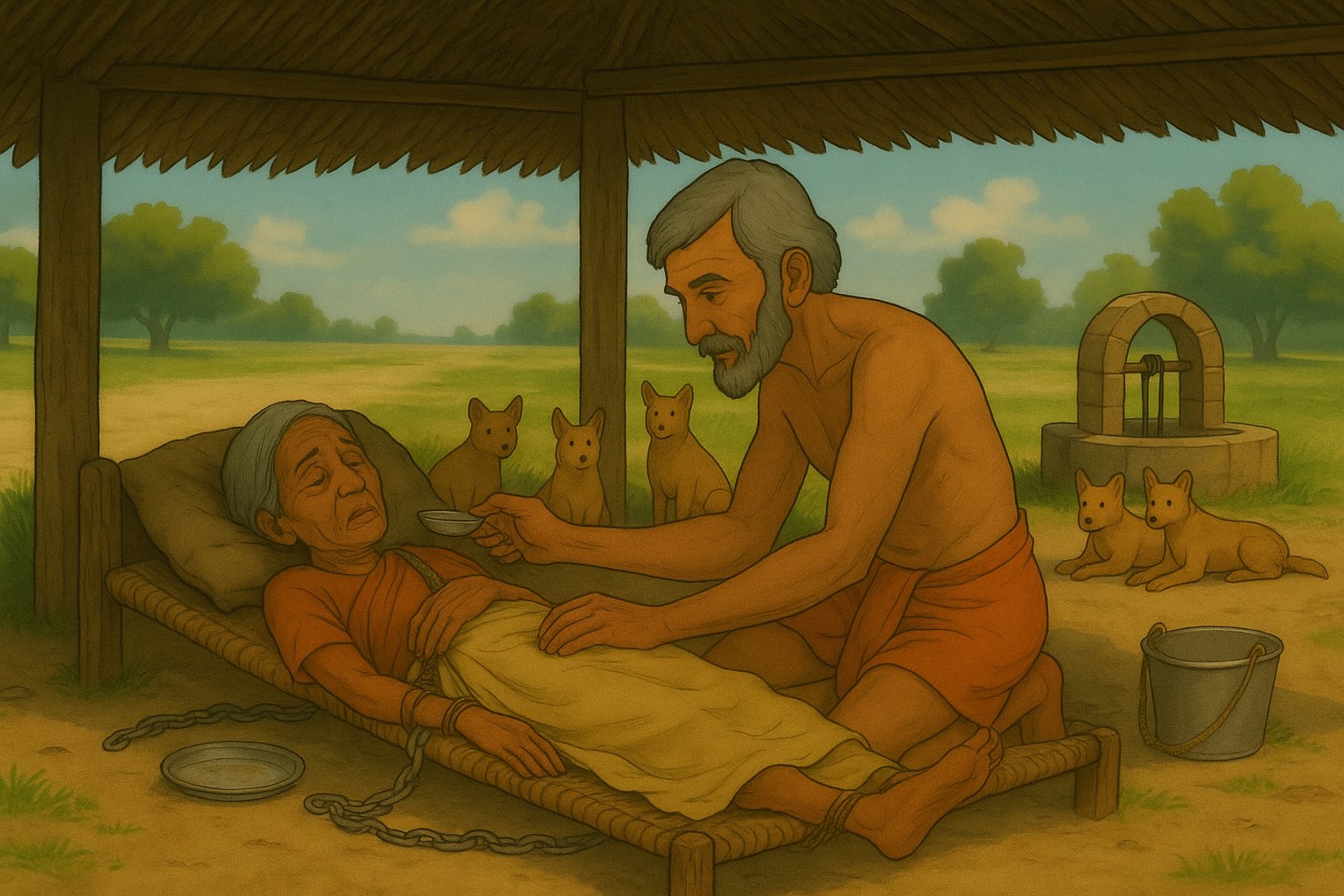
One day, while Atmananda and his entourage were walking past a small town, on its outskirts, they came across an old woman whose leg was chained to a cot under a shed. A couple of dogs sat nearby. An unclean plate with remnants of food lay beside her – likely shared alternately by the woman and the dogs. Her mobility was restricted by the chain.
When Atmananda saw her, he walked towards her. The dogs barked at first but soon began wagging their tails, accepting his presence. As he reached her space, he picked up the plate, carried it to a nearby well, drew water, and cleaned it thoroughly. Inspired by him, the others began cleaning the floor and the area around her cot. The woman, however, seemed to be in deep slumber, unaware of what was happening around her.
Atmananda returned with the cleaned plate, placed it upright near her cot to drain the excess water, and praised his companions for tidying up her space without being asked. Then, quite unexpectedly, he took out a few coins – something none of us had ever seen him carry, as he had no place to keep them in his simple loincloth. Handing the coins to Madhava, he asked him to bring some fresh, warm, vegetarian food. While Madhava went on the errand, we stood silently, watching over the sleeping old woman. The dogs, now calm and trusting, had settled down comfortably around us, sensing no threat.
Whispers of Acceptance
Looking at the sleeping old woman, there was a deep stillness around her, as though she was already dead. None of us could even feel her breath. Soon, Madhava returned with warm porridge in a container, graciously given by the owner of a nearby restaurant, knowing it was for Atmananda. Though Atmananda never stayed in one place for long, his reputation preceded him wherever he went.
Atmananda poured the porridge onto the woman’s plate, emptying the container completely. Handing it back to Madhava, he instructed him to wash it thoroughly and return it to the restaurant owner. Completion of work was very important to Atmananda – he never left a task unfinished.
He sat down near the cot and gently touched the woman’s shoulder, softly calling her “Maa” (mother) a couple of times. Slowly, the old woman opened her eyes and gazed at Atmananda with a blank, uncomprehending stare. For a few moments, she remained that way, trying to make sense of her surroundings. Then, Atmananda gently helped her sit up. As she rose, the chain on her leg pulled taut. Though it was secured with a lock – its key likely with those who had bound her there – Atmananda tapped lightly on the lock, and it sprang open. He removed the chain and gently massaged her legs to restore circulation. Once she seemed more comfortable, he began feeding her.
At first, she resisted the food. It was clear she had not eaten for days, nor had she drunk any water. She was actually dying. Atmananda asked one of us to fetch water from the well. He offered it to her, and she managed a few sips before gesturing faintly with her hand for him to stop. She was too weak to speak. With trembling fingers, she pointed at Atmananda and whispered, “Kaun?” (Who?).
Atmananda replied gently, “Beta” (son) – asking her to see him as her son. She looked at his face in silence, then glanced briefly at the rest of us before returning her gaze to him. At last, in a fragile whisper, she said, “No… God.”
Atmananda smiled softly. “Never mind, Maa. Have some food,” he said, offering it to her with his own hands. This time, she opened her mouth. He fed her a few morsels. After three or four, she gestured again to stop and indicated that she wanted to lie down. Atmananda wiped her lips with water, gave her another sip, and eased her back into bed.
Though her body was little more than skin and bone, a faint radiance appeared on her face after she ate. It seemed as though the food Atmananda had given her was not ordinary porridge but divine nectar – amrit. She almost smiled, or perhaps it was only how we perceived it.
Atmananda then asked, “What more do you want from me, Maa?” She stared at him for a long moment, and then, in a barely audible whisper, replied, “Acceptance… and patience.” Atmananda raised both hands above his head and uttered, “Thathāstu” (so be it). The mother closed her eyes and drifted into sleep.
Atmananda gave the rest of the food to the dogs, waited until they had finished eating, then washed the plate thoroughly and placed it upright near the cot. The mother slept deeply, unaware of all that had taken place.
Turning to us, Atmananda said, “All of you must be hungry. Let us go and eat something, and we shall return to this mother before leaving later this afternoon.”
We went to the nearby river, bathed, and then visited a nearby temple where we received offerings. Hungry as we were, we ate everything given to us. Atmananda ate only a single morsel, out of reverence, for he accepted only temple prasad, and even that, in very small measure.
Afterwards, we rested beneath a tree in front of the temple. When the sun grew less harsh, we got up, completed nature’s call, cleansed ourselves in the river, and then walked with Atmananda back toward the old woman’s shed, about an hour away.
While we were retreading our steps, Atmananda pointed out two people walking towards us. A woman in very ordinary, even discoloured clothes and a teenager in a good and fashionable outfit of the time. Everyone noticed them. They were talking to each other as they walked. Both of them bowed down to Atmananda as they passed us. Atmananda also lifted his hand to bless them.
Soon after they passed us, Atmananda said, “This noble woman works so hard, never allows herself any favour, to give the best to her son. I sincerely hope the son remembers his mother’s sacrifices for him when he stands on his own feet.” What Atmananda said was so obvious in their demeanour.
Atmananda continued, “The chained old woman was also like that. After she lost her husband, she worked hard to look after her only son, and steadily, he grew up and became a police officer. Until then, everything was good. The mother carefully chose a fitting bride for her son, and after marriage, especially after the birth of two children, disagreements started developing between the mother and her daughter-in-law. The mother had no place of her own. She couldn’t go anywhere. Soon, the disagreements became bitter fights at home.
The wife told her husband that his mother has become mad and is hurting her children, and it’s not safe to let her stay with them. The son believed everything his wife said and allowed his wife to take her to a doctor who treats mentally unstable people. He was too busy to go there himself. The wife influenced the corrupt doctor who prescribed her medicines. The medicines induced drowsiness, and the mother was rarely out of her bed. Whenever the son came home, his mother was in her bed. His wife kept telling him to take her somewhere else so that there could be more space in their home.
At first, he ignored it. After falling down a couple of times and getting injured because of her drowsiness, the son decided to chain her to her cot. Her mother kept telling him that she was fine, but it fell on deaf ears. He believed his wife more than his mother. The mother, who was chained to her bed, started getting angrier and more annoyed because of her condition and the bitter feeling of injustice. She started shouting and screaming at all of them, which further convinced the son that she is indeed mad. He shifted her to a shed at the border of his compound, facing the road. That’s where we met her. ” As Atmananda narrated this incident, everyone had tears in their eyes. Everyone felt the pain of injustice in their hearts. Kripa Ram asked Atmananda, “Why did this woman go through such pain in her life? Why did you do what you did for her? How are you connected?”
Atmananda explained, “In her past lives, she ignored and refused to part with food to hungry people who approached her despite her affluence. She could have easily appeased their hunger. She was wealthy. Her acts of indifference when she had the resources to help the helpless brought her to her state of hunger and abandonment. Her daughter-in-law in this life was one of her servants. She was expelled from her duties when another jealous servant complained about her. She did not even ask the version of her current daughter-in-law, as she believed everything her favourite servant said. So the same situation came to her. Her son never listened to her version and completely believed the words of his wife against his own mother. Karma is a complex thing, but no details are missed.” Atmananda concluded.
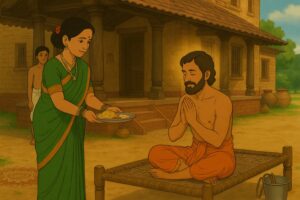
Kripa Ram persisted, “Swamiji, so how did you come here for her? Atmananda smiled. “She gave me food when she was a rich woman. I was a wandering monk. I was both thirsty and hungry. I approached her house, and her servants allowed me inside, knowing that I was a wandering monk. She was the landlady, and when the servants told her that a wandering monk was at the gate, she ushered me in and offered me water to wash and clean myself, and gave me clean, good food until I was full. She respected me by washing the plates and utensils I had used to consume my food. When I asked her what I could give her, she said, “Please bless me to merge with God”. I blessed her, “Tathasthu.”
She also asked me to rest for a while, at least until the sun rays are weak. I rested a while and left before she returned because I had to reach a place before dark. This is what I completed with my current visit to her. I never leave any loose ends, even if I have to travel through lifetimes for it.”
The Promise and the Crossing
When we arrived at the place where the old woman had been, we found a small crowd gathered. Policemen were there as well. We wondered anxiously what could have happened in just the five hours we had been away. Seeing everyone perplexed, Atmananda quietly whispered, “She is no more. The police are trying to figure out whether it was a natural death or a murder. Let them take their time – let us go.”
Without another word, we turned back and walked towards the main street to continue our journey.
Later that evening, Kripa Ram approached Atmananda, who was standing alone by the riverside, watching the boatmen ferry people across to the opposite shore. Troubled in his mind, Kripa Ram could not place the puzzle together. He asked softly, “Swami, may I ask you another question?”
Atmananda glanced at him, smiled, and nodded.
“Swamiji,” Kripa Ram began, “you said that you had granted her wish to merge with God. Why did it not happen in her previous life?”
Atmananda replied, “As I told you earlier, she was kind and respectful to saints and monks, but she was not so kind to her servants and her own relatives. That karma had to be balanced before her final liberation.”
Kripa Ram persisted, “Has it been balanced now?”
“Yes,” Atmananda said calmly. “She endured it all through her starvation, her isolation, and her abandonment. And I, too, completed my promise. I washed her plate and fed her with my own hands. She did not know me, nor did she remember her past lives, but there was no need to explain it. What matters is that no promise can remain unfulfilled. When I gave those morsels of food and water to her, I wiped away the last remnants of her karmic stains. She is now going where she longed to go.
“And remember – just last week Uttarayan began, when the sun turns towards the northern hemisphere. Like Bhishma of the Mahabharata, she waited for the right time for her departure, and for my arrival. The respect and devotion she had shown to monks and masters in her past lives have borne fruit. That earned her this eligibility. She will now ascend to Brahma Loka, where rebirth is no longer driven by karma – it will be her choice alone.”
Atmananda’s words fell like drops of truth into our hearts. A deep silence settled upon us. No one could shake off the weight of that day, nor the quiet majesty of the soul’s completion we had just witnessed.
12 thoughts on “The Last Promise”
What a beautiful rendering of a story full of divinity 🙏🙏🙏 Jai MohanJi 🙏❤️
Samastha lokah sukhino bhavantu
Deeply touching, with wisdom of how to flow ellegantly trough life
Thank you Mohanji
Thank you beloved Father. Saboori! Everything happens when it is the right time to happen.❤️❤️
Beautiful… no words to describe the experience one receives reading such a divine blog… Jai Mohanji … divine and serene.
Gratitude 🙏
Mohanjiii
Thank you ❤️
Sree Guruvayoor
The Atmananda series truly touches our hearts 🙏. Each chapter penetrates the very core of our being, stirring something profound within. We are deeply grateful for these priceless gems you have gifted us, Mohanji 🙏
Past karmas have helped her liberation as I understand.
An eye opener. Waiting for more such
Master’s Grace and Mercy.
Jai Mohanji Baba..
Such a beautiful story about karmic lifetimes – how a karma carries forward in multiple lifetimes. Good karma and bad karma never leaves you ! Jai Mohanji 🙏