Guru Purnima / Vyasa Purnima Satsang with Mohanji
Jul 29th, 2026
The Guru as a Reminder of Who You Are
Guru Purnima – Vyasa Purnima
Mohanji
Wishing you all a great Guru Purnima – Vyasa Purnima. Sage Vyasa was born today. It’s Vyasa Jayanti. Without Sage Vyasa, we would not have known Krishna. He has been instrumental in bringing great definitions of the Sanatana Dharma.
Vedas are from various people. There’s no one author for the Vedas. There are so many people; everybody contributed. Hundreds and thousands of rishis found themselves, found the truth and decided to expound it. Many people did not say anything. They found it. They kept it. They left.
A few people decided to deliver it, and one of them is Vyasa. There have been various Rishis. I’m not going to sit and explain to everybody. Even if you know the story of or Charitra of Sri Rama, Lord Rama, how Rama became a part of our life because of Ramayana. Ramayana has been expounded by many, many Rishis. The most popular is Valmiki’s Ramayana.
Valmiki was a hunter. What was his pedigree? Where did he come from? From the forest.
Hanumanji came from the forest. Van-Nar. We call it Vanar. It’s not Vanar. Vanar means what? It is monkey. Van is what? Van is forest. Nar is human. Basically, tribal. Van-Nar is the tribals of the forest.
Gratitude to the Masters
So great masters who have guided us and protected us are not always from the civilised society, as we speak. Great masters have delivered. And today, especially, we are honouring all the masters, expressing gratitude so that our connection becomes clearer.
When you have gratitude, grace flows. All you need is gratitude.
For gratitude to happen, you should remember. There should be remembrance.
What do you remember? What is the worth of your connection with your master? What is it worth? What is the net worth of the connection with your master?
And this is not for the master.
See, you can consider the guru like the sun. The sun is not concerned whether you appreciate it or not. Mostly, we don’t. When there is bright sun, what do we do? We use an umbrella to protect ourselves from the sun. We do not enjoy the sun.
The Subtle Is Deeper Than the Visible
There was a great master, Avadhoota, who was lying naked on a rock facing the sun during midday. That’s the guy whom Alexander dealt with. And Alexander thought this was a madman. He’s lying totally naked on a rock in the middle of the day under the sun.
Who can do that? You’ll be burnt. He was not getting burnt.
Alexander could not understand that this guy had gone beyond matter. That is why he was able to survive such heat. He didn’t think. We don’t think. Even if we see, we only look at the obvious. What our eyes can show you, ears can make you hear or smell or touch, etcetera. Only the obvious visible.
The master is not the obvious visible. The subtle is much deeper, much more meaningful, and much more transformative than the visible – the subtle.
Vyasa and the Bhagavad Gita
Today is Vyasa Purnima. We should be really grateful to Vyasa because he delivered the Bhagavad Gita. Even when Krishna was delivering the Bhagavad Gita, only two people heard it: Arjuna and Sanjaya.
There were millions of people on the battlefield ready to fight, but they didn’t see him. They didn’t hear him. They might have seen him as a physical form, but they didn’t hear him, nor did they understand him. If all of them heard and understood him, at least 50% of those people would have said no war. If they understood the Bhagavad Gita, imagine all these people who are in the war field; if they understood the Bhagavad Gita, what decision would they have taken? Thank you. No War!
Because it was delivering awareness about you, about your existence, about the relevance of your existence on earth. You!
What are you?
This is explained in the Bhagavad Gita.
Your existence.
What are you here for?
Such as unfulfilled desires, inclinations, patterns, all those things.
Then what is the relevance of your existence? Means, why did you come at all in the larger realm?
To know the truth.
To know that you are the energy which is getting projected through the personality into the world.
You are the energy that is getting projected through your particular personality into the world, and we got deluded that we are the personality.
Just like a feature film. It’s getting projected on the screen, and while it’s active and alive, we believe in it. We experience it. But we should also understand that that’s not the truth. That’ll be like a dream. It’ll be over someday.
An Expression of Gratitude
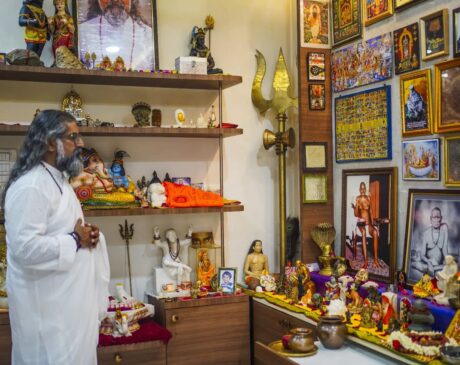
So, this is all told by Vyasa to us. That’s why we are celebrating Vyasa Purnima with such depth. We had our, all the ladies took a bath in the morning, prepared food, offered to all the masters, Datta also. Then, we had Homa. Homa, not our usual Homa. We didn’t do it this time.
The usual Homa that we do, we didn’t do it this time. Why? This is an expression of gratitude.
Enlighten me. The request is, please enlighten me. Let me know what the truth is. Let me know who I am. This is the only request.
And that way we connected to the fire, connected to the masters, Om Gum Gurubyoh Namah, to all the gurus, and then we decided to share whatever we have with everybody.
We had bhog here. Right? Food. The same food is offered to all the masters. We partake of the food. And here, I had insisted that nobody should sit through the program hungry. That is the way Sai Baba taught us. Sai Baba said that food is God for the hungry. So, eat and don’t be hungry.
Instinct, Survival and Sadhana
Who should be hungry during practices? Sadhana? Those who want only God.
For Grihastha Ashrama people, they have to be alive, they have to survive, they have to be stable so that the people around them would be stable. You got it? Better to have food, water, be comfortable. Now imagine you are going to do tapas, penance; then you may forsake food, you may forsake water, you may forsake sleep.
Everything that is instinctual, you may forsake because you are hitting hard on your instinct. Instinct has been given to you as part of the creation for your survival. Instinct. Hunger is an instinct. Thirst is an instinct.
This is all given to you so that you will survive. One of the instincts is fear. Fear, apprehension. That is given to you so that you will either fight if the opponent is smaller than you, less strong than you, weaker than you, or you will take flight. You’ll run away if the opponent is undefeatable.
Who gives this idea to you? It’s built into you. You know this
So, creation is beautiful. Awareness and relevance of it is important.
Gurus Guide You to YOU
That is why gurus have come. Gurus are coming to guide you to YOU. There’s no other job. And if you choose to connect to the master, what you get is clarity.
What clarity? Of what are you made up of, what you are, why you are.
This is the important thing. From there, you have to develop understanding, clear understanding about you and the rest of the journey is moderated by yourself.
Vyasa: Avataric Birth and Purpose
Vyasa Purnima is a very important occasion because we have to be extremely grateful to Vyasa for aligning and structuring the Puranas, Upanishads, and Vedas, all of them. He’s done a great job. A lot of work. So, when somebody does that kind of work, what is behind him?
Imagine he is doing this kind of elaborate work, which will transcend through generations and still be relevant till the end of humankind.
What kind of a power that be?
Avataric birth. Birth of an avatar. Purposeful birth. Birth for a purpose. And that will be consistent, continuous, and always giving. Its relevance will never be eclipsed, ever. People may appreciate or not appreciate, but they will always be relevant.
Now what do you need to have that connection? What are they giving to you?
Reminders.
What does Upanishad give you? Gita, Bhagavad Gita. What do they give you? What does it give you?
Reminder of who you are.
That’s why I said, if all the millions of people, soldiers, chieftains, and great warriors like Bhishma, Drona, if all of them heard the Bhagavad Gita while Krishna delivered, many of them would have said no more. Enough is enough. But they didn’t. They didn’t hear, and they didn’t see who Krishna was.
In the eleventh chapter, when he showed the Vishwarupa Darshana, they didn’t see. Nobody saw. Nobody saw. That is the tragedy of our time. People don’t see the stature of a master and take them in the human context. That’s what happened to Buddha. That’s what happened to Jesus. That’s what happened to all the masters. People took masters as ordinary.
He knows something. Maybe he’s a wise man or he had experience, things like that, but that’s not the point. Where have they come from? What did they come for?
Remind and Remember
All you need is to remember.
They are reminders.
Their job is to remind you about you.
What are you made up of? Why are you here? And all you are doing is remembering.
Two words: remind and remember.
They came to remind you, and your job is to remember. You got it?
Importance of a Guru
I’ll tell you a story about the importance of the guru. Today, it’s all rotating around the guru because it’s Guru Purnima. And the reason why today is considered Guru Purnima is because of Sage Vyasa and the relevance of Vyasa, I already told you. He is the one who introduced us to the incarnations of Maha Vishnu and the relevance of Maha Vishnu at each point in time.
Sage Narada
How many of you have heard about Sage Narada? Most of you. He was a great bhakta of Maha Vishnu. All the time, he chanted the mantra of Maha Vishnu. Narayan, Narayan all the time.
What is Narayan, the meaning of Narayan?
Nar. What is Nar? Human. Narayan means the destination of a human.
Narayan – Human destination.
What is your destination? What is already in you?
The energy. The energy aspect, the soul aspect is your destination. The supreme soul is Narayan. It means the destination of all the souls.
He kept reminding himself – Narayan Narayan, and he believed that he was a great Bhakta, devotee. He went to Maha Vishnu and said,
“Lord, I’m very happy with myself. I’m contented. I’m good. I chant your mantra all the time when I think I am the best of the bhaktas. But you know what? People talk about ecstasy, drunk with God – Mə**st – people talk about it. I am not experiencing that. I experience you. I experience that everything is nice. No problems in life. But I’m not experiencing that ultimate ecstasy. That, you know, what you call that, merger thing. I’m not experiencing. What should I do?”
Maha Vishnu said, ”In that case, you should go to a guru. Only a guru can give you that state, state of ecstasy.”
“Where will I find him?” Sage Narada asked.
Maha Vishnu said, “Go walk on the banks of Ganga early in the morning during Brahma Muhurta.
What is Brahma Muhurta time usually?
3 AM to 6 AM. So that means just before sunrise, walk on the banks of Ganga, and whoever you see first, that’s your guru. Whoever you come across first, that’s your guru. So, he went to Rishikesh, probably Haridwar – started walking from a long distance. He could not find anybody. Nobody was there. He kept walking.
Walking after a while, he decided there’s no guru. He may not get a guru because nobody’s coming. Nobody’s on the way.
Then, after a while, he saw one boat and a boatman. Narada went to him, but he decided, “This boatman can’t be my guru. He’s, after all, a boatman. I’m much more connected to deities, gods. I’m even connected to Maha Vishnu, which is very difficult to connect with – subtle of the subtlest.”
So, he decided not to have him as the guru.
The boatman called him. ”Come, come. I’ll take you across. I will take you across,” the boatman said, but he was not happy.
He said, “No. No. No. This can’t be my guru. I’m a great man. How can I have a boatman as my guru?” He decided, “Thank you very much. I’m fine.”
He went back to Maha Vishnu. When he asked Maha Vishnu, “Was that a practical joke? You told me to walk early in the morning on the side of the Ganga, and you showed me one boatman. Is this boatman supposed to be my guru?”
Maha Vishnu blasted him. “ You are coming back again and again like Kamath, you know, again and again asking the same question, you know, and you don’t understand what I’m saying, and you don’t believe what I’m saying. Again and again, you’re coming back and asking the same question. Get lost. If you want to do what I said, do it. Otherwise, don’t.”
The next day, again, he went, and he walked, and it was all the same boatman, nobody else. When he went close to him, this was Lord Shiva. The boatman was Lord Shiva.
Instructions Are Given for a Purpose
People have mental images of how a guru should be, and they miss the boat. They miss it all the time. When an instruction is given to you, that’s for you. The same instruction may not work for another person. Gurus give instructions specifically for a purpose.
That is why Buddha, when somebody asked him, should I get married? He said, “No. No. No.
That’s not a good idea. You shouldn’t get married. Marriage is terrible.”
Then another person asked, and he said, “Yes. You should get married.”
It’s an amazing thing. If you have a good wife, you’ll be happy. If you have a bad wife, you will become a philosopher. So anyway, it is good. Yeah? This is my addition. Buddha didn’t say that.
A True Master Delivers to the Necessity
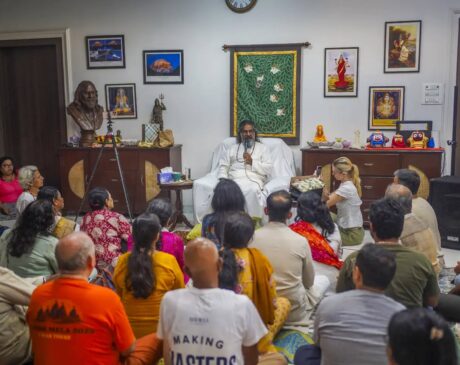
The guru’s delivery would be specifically to the person coming in front, true masters, because they connect to the consciousness and the deficiency, more than the question. The question could be anything, but you can’t depend on the question. A true master delivers to the necessity of the person, not as per the question.
You got what I’m saying?
A true master delivers as per your requirement, not as per the question.
Many people ask a question that is on top of their mind. That is not exactly what they want to know. What is on top of the mind is something which is probably of that time. That’s not what you really want to know.
You may not even know where it started from. Probably it started lifetimes before. You reach a roadblock now, and you keep repeating it. There is a roadblock, but the cause for the roadblock, which probably started lifetimes before. You may not see it, or you may not have the capacity to see it, which is okay. But a true master sorts that thing out. That’s why the rest of the journey becomes very easy, supremely easy.
Receptivity and Stillness
And also, receptivity, the capacity to receive, is very important.
Why do I keep saying, stay still?
See this glass? This glass. What is the capacity of this glass?
The space. How much space? This is half empty or half full. Now what is the capacity of this glass? The half-empty or a half-full space!
Now I’m shifting this up and down for a long time. Can you pour anything into it? That’s why, when you are sitting to receive, stay still. That’s why I keep telling don’t walk, don’t go around, don’t take it casually, because you are wasting your time.
Guru won’t be affected. No Gurus are affected because you are receptive or not receptive. But when you are not available, you don’t receive.
Receptivity is one of the greatest gifts you can give to your guru. Receptivity – being in that mode where you are able to absorb maximum, like a sponge.
That is the reason why I always say, stay still. Stay in one place. Don’t move around because it disturbs other people. Also, you don’t have anything in your pocket eventually.
Karmic Fulfilment and the Role of the Guru
So, you understood a little bit about gurus? Do you have some idea about it? What is the reason for a guru in somebody’s life? What is the reason for a guru at all? Is it because you have something less than the other?
You have everything the same, but your priorities are different.
What’s your priority?
What’s the priority of any individual?
Karmic fulfilment.
For any karmic being, their top priority is karmic fulfilment. They can’t have another priority.
They cannot have another priority. That’s why you took the body. That’s why you are in one place, wherever you are, because it’s all for karmic fulfilment. You are in that particular place, in that particular time, with that particular set of people for karmic fulfilment. Nobody can change it.
Why? Because you came for your unique fulfilments. The purpose of your visit was your own unique fulfilment. It’s not somebody else’s.
If you expect somebody else to be in your shoes, no way. Impossible. Because they are not you. Neither are you them.
So, what is the use of a guru here?
As I said, a reminder.
What is the reminder?
You are not what you seem to be. You are not what you seem to be. You are indeed the consciousness which I have found. No true Master is worried about how much a disciple absorbs.
Deepaka and Perfect Acceptance
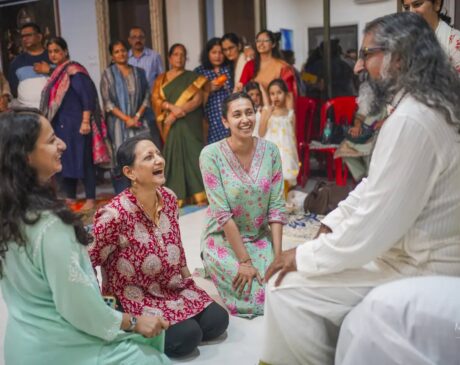
But some disciples absorb and even grow further than the Master. Like the story of Deepaka. He grew above the Master.
What was his way of evolution? His method of evolution?
Perfect acceptance.
How many people can do that? Perfect acceptance. He was accepting the worst of galis (insults) from the master, and situations were not conducive to you, like begging for food in the street. How many people will do it gladly? Very painful. Begging is a very painful thing. Why? Because it hits directly on your ego. It kills your ego, you know. And then, for many of the people who consistently beg, you can see they have accepted that situation and decided to be in that frequency. They made a comfort zone around it.
But being free and having to beg, that’s a sadhana. The Parivrajakas do that.
They don’t stay in one place more than three days. They don’t carry money. They take food only if it comes to them. They don’t make any pre-plans, no belongings, no utensils, no clothes, i.e. minimal clothes and sleep wherever.
How many things do they conquer?
How many dependencies do they conquer?
How many fears do they conquer? E.g. What will happen to me? Or who will serve me? All those fears are gone.
After a while, they become great masters, powerful masters. You see, not the comfort zones. People think that being a spiritual guru is assuring your comfort zone. That’s the worst understanding. A true master is not bothered about it.
A true master is not bothered about it. And a true disciple, to become a master, he can actually even grow beyond that master. By accepting. Deepaka did that. Acceptance, self-acceptance- he decided with huge determination. He decided, “Whatever this guru gives me, I’ll accept.”
Even when Lord Shiva came and said, “What blessing do you need?”
He said, “I don’t need anything, but my guru is unwell. Heal him. Cure him.”
So how can you get Shiva on your side? It’s not easy to connect to Shiva. He’s very powerful. He’s not just powerful. He’s very subtle.
Connecting to Shiva is very difficult. He’s subtle, Sukshma. So not easy to connect. But when he connected to Shiva, Shiva appeared. He said, “Heal my guru, not me.”
And what did Shiva say?
“I can’t do that. I need his permission.”
Free Will and the Karmic Road Map
Here what comes? What comes?
Free will.
Without free will, even the god does not interfere.
Why?
Because of the karmic diagram road map you made. You made the karmic agenda knowingly or unknowingly from birth till death and continue further births and further deaths. No god will intervene. No god will interfere. No guru will do that. You can see Dharma at play here. Everything is Dharmic.
The disciple decided what his clear purpose is; he had clarity of purpose. He had perfect clarity. God also subscribed to it and said, “Let the free will be, not my decision.” And what did the Guru say? I have a little bit of karmic backlog I have collected. If I don’t burn it in this life, I may have to take another life, so let me burn it through this disease. So, is Guru wrong? For the Guru, it is not suffering; it’s completion.
Who will suffer?
Those who resist. The people who suffer are those who resist. Guru was not resisting. He had clarity. He said, “Let me complete this life, this ailment, sickness, whatever, so that I don’t have to come back.” And then he said, “I picked it up”, i.e. this is not his baggage. He picked it up. You look at Dharma at work, righteousness, righteous duty at work; from every angle you can see that righteousness at work.
The Happiness of a Guru
You can grow beyond your Master.
And what made Deepaka especially higher than everybody?
Because of determination, will of steel, no swaying. Even though it was tough, it was very difficult, but no deviation. He got on the right track. The guru was also happy because this fellow was growing.
What is the happiness of a guru?
A disciple becoming a master. Like him or above him? Above him means stature, spiritual stature. If somebody goes above him, that’s the perfect happiness of a Guru. But people usually don’t do that. They’ll say, “Which button to press, you tell me, don’t teach me the whole thing.”
That’s what they say. You know? “Don’t tell me about programming. I don’t want to know your software. Which button to push? You know, shortcut.” This is what people think gurus are for. Anyway, so the guru is happy because the disciple is growing in stature, and he said, as he told him, you will be known all over the world or through time, through generations as a great master. That’s our ultimate pleasure to a guru.
Why Avatars Have Gurus
If you observe, there have been many gurus who guided avatars.
Why do avatars need gurus?
Avatars are born with awareness. They know exactly what to do, who will come, what to give them, when to give them, how much to give them, and what the purpose of existence is. They have full clarity.
But Krishna had Sandeepani as a guru.
What can Sandeepani teach Krishna? What can he give him?
He knew he was an avatar of Maha Vishnu.
What will you teach him?
Discipline.
Not teaching, not methods, not shastras, but discipline.
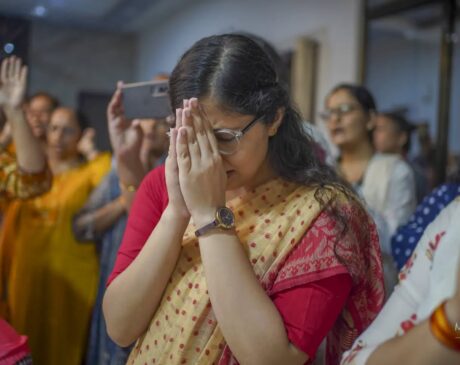
Discipline Is a Must for Spiritual Mastery
Discipline is ultimate for spiritual mastery. Understand very clearly. Discipline is a must for spiritual mastery.
Procrastination, postponing, taking things for granted- all these things are anti-discipline. “Today I am lazy, tomorrow I will get up.” This is not discipline. When you follow a Master, follow a 100% or go and follow the marketplace. There is no need for a Master.
Sri Rama and Vasishta
Sri Rama got a great Master, Vasishta. Vasishta was kind of an intergalactic master. If you read Yoga Vasishta, you will know that the parallel existence of one unit in multiple realms, parallelly or even the cause-and-effect ratio or its balance. All these things he has explained.
That means Sri Rama was very clear about what he was supposed to do later, and you can see the reflection in his life. He had all sorts of problems. See, first of all, he was sent when he was a teenager. He was sent with Vishwamitra when Vishwamitra was doing a Yajna, and he suspected that he would be attacked.
Even now, when you do great work, there will be attacks from negative forces, one way or the other. At least the electricity will go. When you are doing something good for the world, good for the people, some disturbance will happen in the air. Even now we are experiencing disturbance. That situation was there in Treta Yuga also. That’s why Ram was sent by Janaka, his father, to be with Vishwamitra and support and protect the Yajna, which he did.
There were attacks, and Shri Rama and his team managed all that. Then Sri Rama decided there’s no point in going to the city. It’s too false. City is false. Fake. You know, people are too double-faced, triple-faced, four-faced, you know. So, it’s not worth spending time in the cities with the people who are unreal.
Then what did Vishwamitra say?
“No. You are a prince. You will rule your country eventually. You must go back.”
It was painful for Ram to go back. Again, Ram went back, and he was about to be throned. He was about to take his kingdom, become a king in waiting.
And what happened?
He was sent to forest. So, his deep desire to be in the forest came back to him as a reality, but through a different door. Through a different angle, it came back, and then he went through all that he went through,
Eventually, he did not have time with his children. He had to fight with his own son. War.
See, this is what I’m saying. You think that in Avataric birth, they have all the powers, Ashta Siddhis, Nava Nidhis, or even more, but they go through all sorts of tribulations and turbulations and turbulences. That’s what makes them.
Did he ever complain?
Did he ever say life is bad and I am disappointed?
He always maintained his level of acceptance of reality. That is why Ram is worshipped as an Avatar.
Krishna and Practicality
The Guru’s role, the discipline that Ram followed in his life, is the contribution of the great Masters: awareness, the discipline. Krishna is the same. Krishna redefined the old ‘Srutis’ and ‘Smritis’ and everything. In Srutis, it’s absolutely prohibited to lie. Krishna tweaked it.
What did Krishna say? You can lie provided the purpose is good. You know, a white lie is okay. You know why he said that? Because the coming generation is our generation, Kaliyuga.
As much as possible, we will lie. He had to put some kind of a boundary to it. So, he said a white lie is okay if it doesn’t hurt anybody, or keeping quiet is also okay. You don’t have to lie, but keep quiet. Don’t speak.
But if you cannot speak or if you did not speak when you had to speak, your silence will be misinterpreted. This is the problem in Kaliyuga. Imagine you don’t speak when you have to speak. Your silence will be considered as your acceptance. So here, you don’t have many choices.
Okay. So, Krishna set the trend for Kaliyuga, our time. Kaliyuga. He gave absolute clarity. Like, one word: practicality. Be practical before being spiritual; be practical. See, he gave a lot of emphasis on practicality. That’s why he lived his life the way he lived. He lived his life 100% practically. What you have to do, at the time you have to do it. Do it and forget about the results of the action. That’s it. You are not worried about the results of action. This is practicality.
This is being practical. When you have to do something, that time you have to do it, not tomorrow for you. Tomorrow another thing will come. So that is why he is considered the guru’s guru because he squeezed the entire Upanishad, made juice and positioned it as the Bhagavad Gita.
He positioned the entire Upanishad as the essence of Sanatana Dharma and delivered it to Arjuna, and Vyasa brought it to the world for all of us to see.
We don’t see, but that’s a different story. Or we see it conveniently. If it is not convenient, we don’t.
So, these are all great masters. He’s called Jagat Guru. Why?
Because his teachings are eternal. No way you can question his teachings ever, and no way something else can replace them. Krishna’s teachings – that’s why his method of operation was practical. That’s why it was disputable. You can disagree with some of them.
But he only looked at what needed to be done. And he also showed Arjuna that all that he was supposed to do in future has already happened. There’s nothing you’re doing. You’re just a pawn, you know. You’re just an instrument. Things that have to happen have already happened.
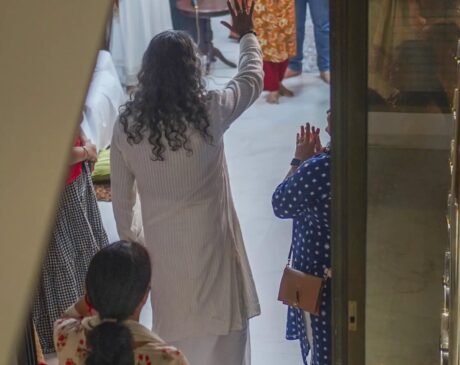
The Cycles of the Yugas
We are in the twenty-eighth Chatur Yuga. Right? Twenty-eighth Chatur Yuga.
Chatur Yuga means what?
Krita Yuga, Treta Yuga, Dwapara Yuga, Kaliyuga. Such a twenty-eighth cycle is running now. This twenty-eighth Chatur Yuga. And 28 times, we might have said the same thing.
How do you know? I mean, 28 Kaliyugas, you would have been Borkar, and I would have been Mohanji. Possible.
You see? There is a repetition. We might have come back. Might have. God knows.
One Manvantara is how many? 28 into seven. Right? (I’m forgetting these things, the signs of being a senior citizen.) Some of these things I can’t remember.
I know very well this is the 28th Chatur Yuga of this Manvantara; 71 Chatur Yugas are the completion of one Manvantara. That’s still about twelve hours of Brahma, half of Brahma’s day. Brahma is not counting hours. Half of Brahma’s day, not full day, is a few Manvantaras. That is a kalpa. Correct? Interesting. (kalpa is 14 Manvantaras)
Questions, Answers and Truth
I think I spoke a lot today. We call it a day. Now you already got a question today. This is not a question-and-answer session. Yeah. I can take one or two questions. This is Guru Purnima. Right?
See, I’ll tell you why questions are useless. No. No. No. That is a different deal.
It’s fine. Okay. One reason is that. Yeah. If you look at our scriptures, most of the Upanishads or things are connected to Samvada, discussion.
Question – answer. Question – answer.
So, who can answer?
Somebody who has known the truth. A person who has only known relative truth means the illusory truth, or in other words, Maya. Can they answer with perfection? They can only give you an opinion.
Is opinion true?
Opinion is your version. Your version as per what you understood or what you experienced.
Is that going to be true?
It is true for you, but I’m talking about the truth. It can’t be.
Three people, four people are sitting here. You know, something happened in this room, or something is happening in this room. If each person is asked, they will give a different version.
Why?
Because you can only see as per what you are. So many of the Samvada, the question and answer, are not real because they are all opinions. Many books are opinions.
Many things which we consider as the thumb rule of social existence are opinions. That’s why they are not permanent.
Who can actually give a proper answer?
Somebody who has understood or experienced truth. Somebody who has experienced truth.
That is why, if you look at many of the discussions, Shiva is talking to Parvati. The questioner is also powerful. Parvati is asking a question which is very important. It needs an answer.
And what is Shiva?
Complete silence. Nirvikalpa Niraakar ananda roopa – all those things, means completely dispassionate, silent, not interested in any of these things. Who is the questioner is also very important.
Where are the questions coming from?
Where the questions are coming from is very important.
Understanding Maya
Many questions are coming only from the level of illusory mind, mind which handles illusion. You need to understand what Maya is to understand what illusion is.
You have relatives. Are your relatives Maya?
Imagine you have father, mother, children, husband, wife, whatever. All are illusion?
We say Jagat Mithya – the visible world is an illusion.
Okay. Tell me, are they an illusion? Are they Maya?
They can’t be Maya. They’re eating food, sleeping, scolding you, fighting with you.
It can’t be Maya. Right?
So, what exactly is Maya then?
Your connection with it. Ownership.
I own this person. The Maya side is that your non-understanding is Maya. You believe that these are my people. This is mine. I am me. This is mine. That is Maya. Everybody is existing. Everything is there.
This world around you, the fruits, the trees, the plants, they’re not Maya.
They all have existence. But how you connect to them, that’s Maya, the non-understanding which creates pain or pleasure.
Are you clear about this?
You need to; if you don’t know what Maya is, then this whole thing will not make sense. Then you will not even understand why Shiva is answering questions the way he is answering.
Maya means your non-understanding of everything. That is exactly what’s happening in the world. This is my territory. That’s your territory. I don’t speak your language, so you are my enemy. Everybody’s god is somebody else’s devil. Why is it so? Because of the understanding or the connection.
Have you seen in the whole history of religions that everybody’s God is somebody else’s devil?
You know, they create the devil as per the form of a God of another tribe. This is how they work. This is how it happens. So, it’s very important to understand that Maya is our awareness about these things.
The moment you understand that you are indeed the metaphysical, even the body is a projection, and all these relationships you have created around it are only for experience’s sake, then you understand truth. Nothing belongs to you.
Nothing belongs to you. But you can’t say that my house is Maya. You know? Are children all Maya? It’s not possible.
People have misunderstood it so much, so they don’t know the boundary. You see? To the level where escapism is also okay by thinking like this. The scriptures have said, Jagat Mitya. It’s our illusion. I’m not taking care of my family. They’re an illusion to me. Non-understanding. So, when Shiva is explaining things to Mother Parvati, he’s explaining things from the level of truth to that of truth, which means removing all the aspects of Maya. He’s delivering truth to another aspect of him, which is truth.
You have to understand those in those lines, those words, then all that remains is truth. And to understand Shiva, you need to know, like, we are going to Kailas now, so it’s good to talk about it also. That deletes many of the questions. Right?
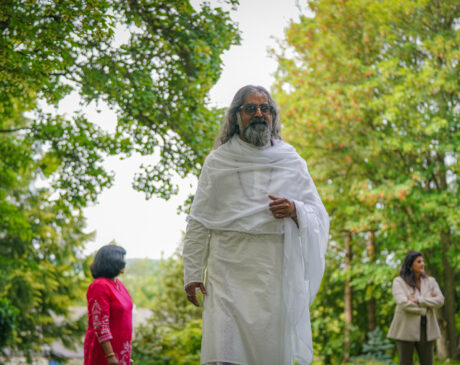
Why We Go to Kailas
So, why are we going to Kailas?
They said this is the ultimate pilgrimage of life, human life.
You look at how Shiva is. He lives in places which are inaccessible normally. All the places, all the Pancha Kailas you take, all are very difficult to access.
He stays so far away from all the jhamela (issues) of life. You know! All the glitter of life, he stays away. He stays in places where it’s unless you’re so determined, you can’t reach.
What does that mean? You come if you have to come. For what? Not to go back the same way. To leave yourself and go back. Come with your Maya, go back with truth. This is one reason.
The Nature of Shiva
Now another thing. See, you look at history. We had the Samudra Mantan, churning of the milky ocean for getting immortality, to get Amrut – celestial nectar, for immortality.
And, what came first? Poison.
Tremendous poison, which had the power to destroy two into seven fourteen lokas, including Earth. Bhuloka. Who consumed it? Shiva. He did not wait for Amrut to come. He drank the poison.
All the Devas, Devatas, Yakshas, Gandharvas- nobody touched it. Shiva consumed it. He is accepting things which nobody wants. You know, if he said, can you have a little bit of poison? No. Thank you. You handle it. Nobody wants to share, but he consumed it.
And Mother caught his neck, and she saturated it on the throat. Because if he vomits it out again, the whole thing will be burnt. If he swallows it, then he will stop existing. It was saturated at the throat level, Neelakanta (blue-throated one). So he accepts things which nobody accepts.
He stays in places which nobody wants, and he gives blessings. If you land up to him, he gives everything. He never thinks.
Why is he like that?
He said, “You took the trouble of coming to me. Take whatever you can.”
And it might be people who are not worth blessing, many times.
Then Vishnu has to sort it out. But why is Maha Vishnu sorting it out? Because his job is to maintain. So, that’s why Shiva is completely innocent. He’s completely innocent. Innocent means he doesn’t think; he just gives, “Oh, you have come here all the way. Okay. Take whatever you want.”
That is why he gave Atmalinga to Ravana. Ravana’s interest was supremacy. Supremacy means supremacy over Deva Loka, too. But Shiva never cared. He said, “Okay. You want to take it, take it.” This is exactly how he operates. So, you need to understand the nature of Shiva. Completely innocent, just a matter of fact. Even if it is a problem for him, he doesn’t have a problem. By drinking poison, it’s not going to make him healthier, but he drank it anyway because nobody else will do it. Maybe he offered it to some people, and they all ran away.
But the point is that no way he can be destroyed. He’s indestructible. So, a person who exists as truth, in truth, is eligible to deliver truth to the people, to the others. And all the practices he has said, all he had recommended, everything is to make your stature like that.
The Highest Gift a Master Can Give
That is the highest gift any Master can give to any disciple: the stature that he is operating in.
But the disciple should be firm and stable. Consistency is extremely important, like conviction. Believe in what you do.
Most people do things mechanically, like, for example, Kriya. Very powerful technique. It transforms you. But if it’s a ritual, do you think you will grow? Okay. I’m doing Kriya.
I did it so many times. Nothing is happening. Vertical, horizontal, vertical. This way you don’t progress. Whatever you do, do it with awareness.
Know Before Believing
That is why I always say never have blind faith in anything. Don’t follow or don’t connect to anybody blindly. Blind faith is disastrous to you. Blind faith is disastrous because when you are blind, you are unreasonable. You just follow blindly. Always keep your awareness alert.
That way you are on the time, in the present. This is essential for progress.
Now blind faith is like, “Okay. You made the machine. You put the software. Now let me press it.” Or “You brought the materials from the supermarket, you prepared food, I’ll eat.” It’s not like that. You should participate. You should understand. You should know. Know, before believing. That is our path, Raj yoga path, you say. You should know before you believe. When you know, you don’t have to believe.
Why do people believe in something? Because you don’t know, and that leads you to further illusion. Our aim is to come out of illusion, ownership, expectation. So what’s the point in adding more illusions? So, know. Once you know, you are clear. When you know, what will happen? Clarity. You will be very clear. And when clarity is there, your effectiveness is more.
When you do something with clarity, you are more effective. That is why great doctors, great physicians or artists do great works because they are very confident, because they are very clear.
Those who are neither confident nor clear always do things half as ugly. There will be no effectiveness, there will be no growth. As true disciples, you must gain clarity through knowing.
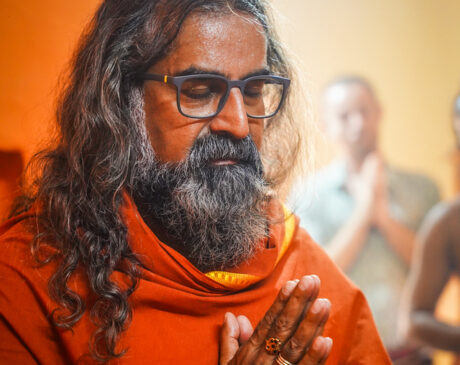
Contemplation Is Penetration
That means for knowing, you need to do manana, contemplation. Contemplation is penetration. What is contemplation? Not analysis.
Don’t confuse analysis with contemplation. Many people believe contemplation is analysis. What’s analysis? It’s like you’re chewing on the same thing, trying to get more and more juice out of it. After a while, will you get anything?
What is penetration? Contemplation means you’re going to the core of it, and it’s like peeling the seed. Keep peeling, keep peeling. After a while, nothing. So you found nothingness in somethingness. That is contemplation.
Analysis is your trying to understand something intellectually which you cannot understand intellectually. You got it? This should be very clear. As sadhaks, you should know this.
If somebody asks what the difference between contemplation and analysis is, Mohanji said something. This is not that. I said, but we should tell clearly. We should tell clearly this is what it is. See, have you ever seen me giving you any answer without clarity?
Then why are you sometimes not answering with clarity? I don’t understand that. When people ask a question, why are you fumbling? I have always given clarity. Any piece you take, even a small, micro, macro piece, I have given clarity from whatever I am teaching.
But then, when you answer, I have seen that you are beating around the bush; you are going all over. Why is it so? What is lacking? What is blocking it? If you have further doubts, you can ask me. I have answered this every week. We are answering. Every week, pretty much, different, different track, but same things. I’m giving different dimensions.
Clarity, Consistency and Conviction
I would like you to answer with clarity because then people will know that you are actually walking the Raja Yoga path. You must have clarity. Clarity is very essential for this. Without clarity, it is blind faith. I don’t want anybody to have blind faith in me. Have I ever promised you enlightenment? I never promised such things. I never told you I am enlightened. I don’t even know whether I am enlightened.
It really doesn’t matter. Because even if you are enlightened, you need to have your meals a day, your food, you have to take a bath, you have to go to the toilet, everything you need. So, all these things are not important. Your operating level determines your relevance. Your operating level and scope of work determine your relevance. And that’s what it talks about. That’s the only thing that matters eventually. Correct?
What you are delivering matters. If you’re not delivering anything, whatever you do doesn’t matter to the world. What you deliver matters. Consistency matters. Clarity matters. Conviction matters. Other things don’t matter.
So the point I am saying is that when people ask a question, be very clear in your answer. Get that clarity. Then you can avoid all this blind faith stuff.
Somebody said Mohanji is good, so I am also following. Why are you following? You are not a cow. One cow goes, and everybody goes behind the cow. You have to follow with your own conviction. That needs understanding, and I will not be upset if you don’t follow me. I’m telling you now. It’s not at all a problem for me.
But I’m saying, if you’re with me, I would like you to have clarity about why you are with me. Then we have something to do together.
Information, Knowledge and Transformation
So, know. For knowing, you need to churn the information – not analysis, but contemplation.
Then how can you make it your own? When you eat food, imagine you’re eating food. It’s on the table, tasty food; you ate it. How does it become yours? Imagine you have loose motion. All the food goes out. Does the body get anything? Nothing.
Now imagine you ate; you have good digestion. What happens to the food? It’s disintegrated. What is necessary is taken. The rest is expelled. This is exactly how information should be handled.
You get the information, do manana, which is breaking it up and getting the essence out of it, leaving the trash, and using it as experience. When it becomes experience, what happens? It’s yours. It’s yours. Then it’s yours. 100%.
Like the food becomes you when it’s completely disintegrated, and the essence is absorbed by the body. Like that, information is churned, the essence is taken, garbage is removed; that becomes you. That becomes your transformation. That becomes your transformation.
Only then are you transformed. Otherwise, people read thousands of books. Nothing happens. Isn’t it? From birth till now, how many movies have you watched? How many movies? Do you remember one more than two or three? Why? Because they are not important. Yeah.
The one you just saw, you felt something, and then that’s it. Next time when you see it on the screen, you say, “Oh, I watched it before.” Memory may happen, but remembrance is not there. Why? Because it is not important. It is not important.
But we remember one Ben Hur or one Titanic or something because that gives you an impact. You experienced something. When you experience, you remember. Life is like that. What you experience, you will remember.
Otherwise, you won’t. So, this you should remember: information processed becomes knowledge. Knowledge experienced becomes transformation. This has to be very clear, clearly understood.
Results of Action and Karma
Tanuja:
You said that the results of our actions are not important. What do you mean by that? Don’t the results of our actions create karma and karmic consequences?
Mohanji:
With the results of action, we have no control. We have only control over action. What we do, we have grip. We can do or not do. We can also decide that.
But what comes out of it, we don’t know. For example, two people make love and a child comes. Do you know which child is coming? It’s like that. Every day in life, we do actions.
We do so many activities, but we have no idea what is coming out of it.
What creates karma is the ownership part. This is me. This is mine.
The ownership keeps that emotion in our subconscious, and that brings forth that brings forth karma. Our action is mostly an expression of what is already there. An action happens in a circumstance. You need an environment for an action. That action’s environment is provided by destiny, which is a karmic plan. Karma planned that atmosphere, and you are performing that thing. And that performance you can do, but the result of it you have no control over. It is not always predictable. To some extent it is predictable.
When you get up in the morning, there is electricity. When you switch it on, the light comes. That’s predictable. But only when there is electricity. If it is like Ganeshpuri, you have to check the horoscope. That day is whether there will be electricity today. So, it all depends on various circumstances.
So, we have no grip, and the result of the action is not the thing which attaches to karma. That’s mostly fulfilment. What makes it karma is our resistance or our non-acceptability of the result. That makes karma. Means when we fight against something, when we resist something, that emotion is getting stored more in our subconscious.
Through acceptance, it wipes away. It goes, okay, this is happening, no problem, And it goes away. But resistance keeps it.
Sri Guruvayurappan meditation
Mohanji:
Yeah. Right. Who’s playing the meditation?
Participant:
Sri Guruvayurappan meditation. This meditation is similar to visiting the majestic and powerful Guruvayur Temple in Kerala, India, being in Guruvayurappan’s blessed presence and communing with him. Cleanliness is important. Before practising this communion, we must cleanse our inside and outside as we would if we were coming into his presence. Brush your teeth, bathe, and cleanse your body.
If you have sandalwood paste or kalabham from the Guruvayur Temple, apply it to your forehead, neck, chest, stomach centre and spine. Wear clean clothes. Cleanse the space where you sit for this meditation. Sit on a chair, a mat, or on the floor. Thank you.
Mohanji:
Thank you so much. This is now open to the public on YouTube. But this is, understand this is not a meditation. This is more like a trip to the temple. So, you’ve got to take time and do it.
Only then will you feel it. If you think this is like a meditation, it’s partly a meditation, but it’s not exactly a meditation. It’s like you go to the temple, and you feel. You go to the temple with awareness, and you feel the presence of the Lord and enjoy that experience and come back home.
Remember Your Connection with Your Guru
Anything else? We call it a day. Thank you very much. I wish you a great Guru Purnima. Even though it is today, every day you should remember your connection with your Guru just as a reminder of who you are.
The only reason for this connection is this reminder. Who’s walking the path? You’re walking the path. For whom? For you.
And don’t think that the Guru needs something from you; it’s you, you, and you. It’s your journey, your awareness, and your dissolution. So, this has to be very clearly understood so that your connection with the Master is always bright and shining. Expectations cloud it. The more the expectation, the less the connection. You know? More ownership, you lose the guru. Ownership becomes possessiveness. Wish you all the best. Lots of love.